
If you’ve heard scratching in the walls at night or found droppings near your pantry, you’re not alone. Illinois homeowners and business owners deal with rodent problems every single year, especially as temperatures drop and rodents search for warmth, food, and shelter indoors. Understanding the common types of rodents found in Illinois is the first step toward protecting your property, your family, and your health.
This guide breaks down the most frequent rodents invading homes across Illinois from tiny mice to full-grown rats so you can identify what you’re dealing with, understand how serious the risk is, and know when it’s time to call in professional help. Whether you own a single-family residence, a rental property, or a commercial building, this article will help you recognize the warning signs before a small problem becomes a full-blown infestation.
If you’re already noticing activity in your home, our team offers trusted Rodent Removal Services in Illinois to safely and permanently remove rodents from your property.
House Mice: The Most Common Rodent Found in Illinois Homes
Among all types of rodents in Illinois, house mice are by far the most frequently reported. These small, grayish-brown rodents measure only 2.5 to 3.75 inches long, not including their tail, yet they can cause disproportionate damage for their size.
House mice are highly adaptable and thrive in both urban and rural environments. They prefer to nest close to food sources, which is why kitchens, pantries, basements, and wall voids near appliances are common hiding spots. A single female house mouse can produce up to 8 litters a year, with 5 to 6 pups per litter, which means an unaddressed problem can spiral out of control within just a few months.
Homeowners often ask What Do Mice Eat once they discover chewed food packaging or gnaw marks on cardboard boxes. The answer is almost anything mice are opportunistic feeders that consume grains, seeds, pet food, and even soap or glue if food is scarce. This adaptability is one reason house mice are considered one of the most persistent common household rodents in Illinois, capable of surviving in nearly any indoor environment.
Because house mice reproduce so quickly and squeeze through gaps as small as a dime, early detection and sealing of entry points are critical for long-term control.
Deer Mice: A Wildlife Rodent That Often Moves Indoors
Unlike house mice, deer mice are typically found in rural, wooded, or agricultural areas surrounding Illinois neighbourhoods. They have a distinct two-toned appearance brown or reddish fur on top with a white underside and white feet which makes them easy to distinguish from house mice once you know what to look for.
Deer mice usually move indoors during colder months when outdoor food sources become scarce. They’re commonly found in garages, sheds, attics, and storage areas rather than deep within living spaces, though they can migrate further into a home if conditions allow. Homes near wooded lots, farmland, or open fields in Illinois are at a higher risk of deer mice activity compared to homes in dense urban areas.
What makes deer mice particularly concerning isn’t just property damage it’s the health risk. Deer mice are the primary carriers of hantavirus in North America, a serious and potentially fatal respiratory illness transmitted through contact with rodent droppings, urine, or nesting materials. Because of this risk, any suspected deer mouse activity in a garage, cabin, or storage building should be treated with extra caution, including proper ventilation and protective equipment before cleanup.
Norway Rats: Illinois’ Most Destructive Rodent
Norway rats, also known as brown rats or sewer rats, are the largest and most destructive rodents commonly found throughout Illinois. Adults can grow up to 16 inches long, including their tail, and typically have coarse brown or gray fur with a blunt nose and small ears.
These rats are burrowing rodents, meaning they prefer to nest at ground level rather than climb. Common nesting sites include basements, crawl spaces, foundations, woodpiles, and areas near sewer lines or drainage systems. Norway rats are strong, persistent chewers capable of gnawing through wood, plastic, soft metal, and even electrical wiring, which creates a serious fire hazard in both residential and commercial buildings.
Because of their size and strength, Norway rats cause significantly more structural damage than mice. They also carry a wide range of pathogens and can contaminate stored food, insulation, and food-prep surfaces in commercial kitchens. For business owners managing restaurants, warehouses, or retail spaces, a Norway rat infestation can quickly become a code violation or health inspection failure if not addressed immediately through professional Pest Control Illinois services.
Roof Rats: The Climbing Threat to Attics and Roofs
While Norway rats stay low to the ground, roof rats sometimes called black rats — are excellent climbers. They’re slightly smaller and sleeker than Norway rats, with larger ears, a pointed nose, and a tail longer than their body, which aids their climbing ability.
As their name suggests, roof rats prefer elevated nesting sites such as attics, rooflines, upper wall cavities, and dense trees or shrubs near a building’s exterior. In Illinois, roof rat activity tends to increase in late summer and fall when outdoor food sources like fruit and seeds become less available, pushing them toward homes and commercial properties.
Roof rats are particularly problematic for two-story homes, apartment buildings, and commercial properties with overhanging trees or vines that provide easy access to rooflines. Once inside an attic, they can chew through insulation, wiring, and wood framing, often going unnoticed until damage is extensive. Identifying roof rat droppings which are spindle-shaped and typically found in elevated areas can help distinguish this species from ground-dwelling rats early on.
How Rodents Enter Homes and Businesses in Illinois
Understanding how rodents enter homes is one of the most important parts of prevention. Rodents are remarkably skilled at exploiting even the smallest weaknesses in a building’s structure. Common entry points include:
- Gaps around utility lines — openings where pipes, cables, or vents pass through exterior walls
- Foundation cracks — even hairline cracks can widen over time and provide access
- Gaps under doors — especially garage doors, basement doors, and loading dock entrances for commercial buildings
- Vents and chimneys — unscreened openings that allow rodents to climb inside
- Damaged weatherstripping and window seals — worn seals create easy openings, particularly in older Illinois homes
- Overhanging tree branches and vines — these give roof rats and other climbing rodents direct access to rooflines
- Openings around HVAC systems — gaps left during installation or repair work are frequently overlooked
Because mice can squeeze through openings as small as a quarter-inch and rats through openings around a half-inch, even minor gaps around a foundation or roofline can be enough for rats and mice in homes Illinois to establish a foothold. Sealing these access points is one of the most effective long-term defenses against future infestations.
Signs of a Rodent Problem You Shouldn’t Ignore
Recognizing the early signs of rodent problem activity can save property owners significant time, money, and health risk. Some of the most common warning signs include:
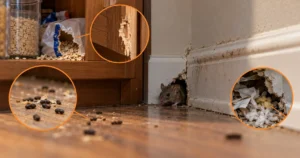
Droppings near food storage areas, along baseboards, or inside cabinets are usually the first indicator of a rodent infestation. Gnaw marks on wood, wiring, plastic containers, or cardboard boxes also point to active rodent presence, as does the discovery of shredded paper, fabric, or insulation used for nesting material.
Property owners may also notice greasy rub marks along walls or baseboards, caused by the natural oils in a rodent’s fur as it repeatedly travels the same path. A persistent, musty odor — particularly in enclosed spaces like basements, attics, or wall cavities is another common sign, along with unexplained pet agitation, since cats and dogs often sense rodent activity before humans notice any visible evidence.
If you’re seeing any combination of these signs, our detailed guide on How to Get Rid of Mice in Illinois | Homeowner’s Guide walks through practical next steps for addressing an active problem before it spreads further into your home.
Rodent-Borne Diseases: Health Risks You Need to Know
Beyond property damage, one of the most serious concerns tied to rodent activity is health. Rodent-borne diseases (hantavirus, Salmonella) pose real risks to both homeowners and employees in commercial spaces.
Hantavirus, primarily linked to deer mice, spreads when people inhale airborne particles from dried rodent droppings, urine, or nesting materials, often during cleanup in enclosed spaces like sheds, cabins, or storage areas. Symptoms can range from flu-like fatigue to severe respiratory distress, making prompt and careful cleanup essential.
Salmonella contamination is another significant concern, particularly for businesses in the food service or hospitality industry. Rodents can contaminate food surfaces, storage containers, and prep areas simply by walking across them, transferring bacteria that can lead to serious foodborne illness. Other health risks associated with rodent activity include leptospirosis, rat-bite fever, and allergic reactions triggered by rodent dander and droppings, which can be especially problematic for individuals with asthma or respiratory sensitivities. Given these risks, DIY cleanup of significant rodent activity is not recommended without proper protective equipment and ventilation.
Rodent Prevention Tips for Illinois Homeowners and Businesses
Prevention is always more cost-effective than dealing with an active infestation. Here are practical rodent prevention tips that apply to both residential and commercial properties throughout Illinois.
Start by sealing all visible gaps, cracks, and openings around your building’s foundation, utility lines, and rooflines using steel wool, caulk, or metal flashing, since rodents can chew through softer materials like plastic or standard foam sealant. Store food, including pet food, in airtight containers rather than original packaging, and avoid leaving pet food or water dishes out overnight.
Keep firewood, mulch, and dense vegetation at least 18 to 24 inches away from your building’s exterior walls, since these create attractive nesting environments close to potential entry points. Trim tree branches and vines that overhang your roofline to eliminate easy access for roof rats. Inside the home or business, regular inspection of basements, attics, and storage areas can help catch early signs of activity before it escalates.
For ongoing protection, especially for commercial properties required to meet health and safety codes, scheduling routine inspections through professional rodent control services Illinois ensures early detection and consistent monitoring throughout the year, rather than relying solely on reactive treatment after an infestation is already underway.
Frequently Asked Questions
1. What is the most common type of rodent found in Illinois homes? House mice are the most frequently reported rodent in Illinois homes due to their small size, rapid reproduction rate, and ability to squeeze through very small openings around a building’s structure.
2. How can I tell the difference between a mouse and a rat infestation? Mice leave smaller, pointed droppings and tend to nest closer to food sources indoors, while rats leave larger, capsule-shaped droppings and often create burrows near foundations or nest in elevated areas like attics, depending on the species.
3. Are rodent droppings dangerous to clean up myself? Yes, dried droppings can release airborne particles linked to hantavirus and other illnesses. It’s important to ventilate the area, wear gloves and a mask, and avoid sweeping or vacuuming droppings directly, as this can spread contaminated particles into the air.
4. How quickly can a rodent infestation grow out of control? Because mice can reproduce every three weeks, a small population can multiply into dozens of rodents within just a few months if entry points and food sources aren’t addressed promptly.
5. Do rodents only invade homes in winter? While cold weather drives many rodents indoors seeking warmth, activity can occur year-round, particularly in commercial buildings, garages, and homes near wooded or agricultural areas where outdoor food sources fluctuate seasonally.
6. What’s the most effective long-term solution for rat and mouse control? Combining sealed entry points, reduced food and water access, routine property inspections, and professional treatment offers the most reliable long-term rat and mouse control, rather than relying on a single method like traps alone.
Rodent problems rarely resolve on their own, and by the time signs become obvious, an infestation is often already well established. Whether you’re dealing with house mice in the kitchen, roof rats in the attic, or Norway rats near your foundation, identifying the species early makes treatment faster and more effective. If you suspect rodent activity in your Illinois home or business, reaching out to a professional pest control team can help you address the problem safely and prevent it from returning.