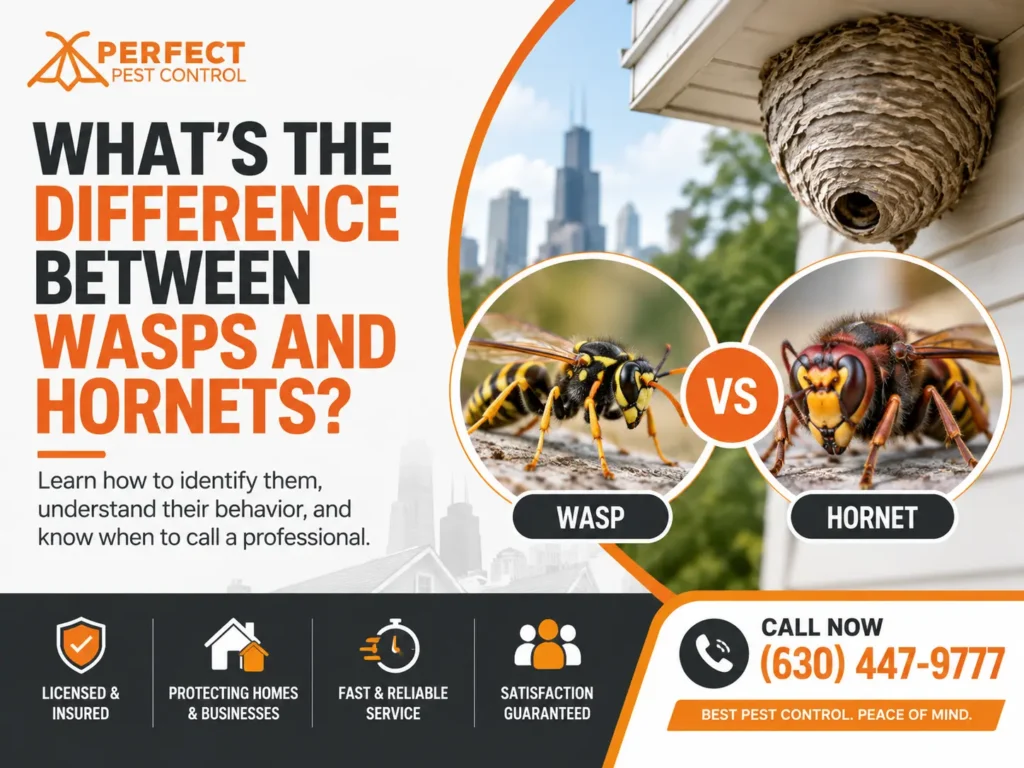
If you see a large stinging insect around your porch, roofline, lawn, patio, or business entrance, you may wonder: what’s the difference between wasps and hornets? The simple answer is that hornets are a type of wasp, but not every wasp is a hornet.
For Illinois homeowners and business owners, correct identification matters. A nest under an eave may belong to paper wasps, activity from a ground hole may point to yellowjackets, and a large gray paper nest in a tree may belong to bald-faced hornets.
Perfect Pest Control LLC helps residential and commercial property owners identify stinging insects and choose a safer removal plan.
Why Wasps and Hornets Are Often Confused
Wasps and hornets are closely related, so they share many features. Both usually have smooth bodies, narrow waists, wings, and the ability to sting when threatened. Hornets are simply a more specific group within the wider wasp category.
Illinois Extension explains that true hornets belong to the genus Vespa. The European hornet is a true hornet found in North America. The bald-faced hornet, despite its common name, is not a true hornet and is more closely related to yellowjackets.
If you search for the difference between hornet and wasp, the easiest way to remember it is this: “wasp” is the larger group, while “hornet” refers to certain wasps with their own appearance and nesting habits.
Key Differences Between Wasps and Hornets
For most property owners, these are the most useful differences to know:
- Appearance: Many wasps are slim and narrow-bodied. Hornets are often larger and more heavily built.
- Color: Paper wasps may be brown, reddish, black, or yellow-marked. European hornets are usually reddish-brown with yellow or orange markings. Bald-faced hornets are black with white markings.
- Nests: Paper wasps often build open combs. Yellowjackets may nest underground or in wall voids. Bald-faced hornets build enclosed gray paper nests, often above ground.
- Behavior: Many wasps avoid people when left alone, but social species may strongly defend their nest.
- Property risk: A colony becomes more concerning when it is near doors, decks, walkways, playgrounds, outdoor dining areas, loading zones, or other busy spaces.
How to Tell a Wasp From a Hornet Around Your Illinois Property
Look at the insect’s body, markings, nest style, and where it keeps flying. Paper wasps often have long legs that hang down in flight and build open nests under eaves, railings, sheds, and porch ceilings. Yellowjackets are more compact and may disappear into the ground or a small opening in a building.
Bald-faced hornets are mostly black with white markings and often build large enclosed paper nests in trees. European hornets are larger and may use hollow trees, attics, or wall voids. If you cannot identify the insect from a safe distance, Pest Control Illinois can help you avoid disturbing the wrong nest.
Common Wasps and Hornets Found in Illinois
Illinois has many wasp species, including solitary and social insects. Some are beneficial because they hunt caterpillars, flies, crickets, and other pests. The species that cause the most concern around homes and businesses are usually social nest builders.
When people search for types of wasps in Illinois, they are often trying to identify paper wasps, yellowjackets, bald-faced hornets, European hornets, mud daubers, or cicada killers. These insects do not all create the same level of risk.
The search phrase Wasp Illinois can bring up many different insects, so nest location can be as useful as color or size. The phrase hornet and wasp species also covers many insects, but the practical question is whether the nest is close enough to people to create a sting risk.
If a nest is close to a porch, business entrance, playground, patio, loading dock, or other occupied area, Wasps & Hornets Removal Services in Illinois can provide a safer solution than guessing at the species and treatment.
Hornets and Wasps Have Different Nesting Habits
The hornets and wasps difference is easier to understand when you compare their nests. Paper wasps make exposed combs with visible cells. They commonly attach them under eaves, rails, ledges, and other protected surfaces.
Yellowjackets may build enclosed nests underground or inside structural cavities. Bald-faced hornets build gray enclosed nests that can look like a paper football hanging from a tree branch. European hornets often use protected cavities such as hollow trees, attics, or wall spaces. Illinois public health guidance describes these different nesting patterns and warns that hidden nests can be difficult to manage safely.
If insects are entering the same crack, soffit, wall opening, or tree cavity over and over, do not seal the entrance while the colony is active. Blocking it can force insects to search for another exit.
Wasp vs. Hornet Stings: What Illinois Property Owners Should Know
People often ask about the difference between wasp and hornet sting because hornets can look larger and more intimidating. Both can deliver painful stings, and social wasps and hornets may sting more than once when they feel threatened.
The seriousness of a sting depends on several factors, including the number of stings and the person’s sensitivity to venom. Insect stings can also trigger anaphylaxis in some people. Trouble breathing, swelling of the face or throat, dizziness, or other signs of a severe allergic reaction require immediate emergency care.
Do not hit, spray, or block an active nest when people are nearby.
Which Stinging Insect Creates More Risk Around a Property?
If you are asking are wasps or hornets worse, there is no single answer. A small paper wasp nest high under an unused roof edge may be less urgent than a yellowjacket nest beside a front walkway. A bald-faced hornet nest high in a tree away from people may also create less daily risk than a hidden colony inside a wall near a busy entrance.
The most important factors are species, nest location, colony activity, and how often people pass close to it. Pay extra attention to nests near children, pets, decks, entrances, outdoor dining, delivery zones, and public walkways.
This explains the difference wasps and hornets in a practical way: the level of risk depends more on the colony and its location than on the insect’s name alone.
When a Wasp or Hornet Nest Becomes a Problem
Not every wasp flying around flowers needs control. Wasps can help reduce other insect pests and can also visit flowers.
Watch for repeated insect traffic around one hole, crack, tree cavity, roof edge, soffit, utility opening, or patch of ground. If you see regular activity but cannot find the nest, avoid opening walls or disturbing the area.
A nest near a front door, garage, deck, playground, customer entrance, employee work area, outdoor dining space, or loading area deserves more attention because people may pass close to it several times each day.
How to Get Rid of a Wasp Nest More Safely
If you searched how to get rid of wasp nest, first decide whether the nest is safe to approach. A small, exposed nest in a low-risk area is very different from a large colony, underground nest, high nest, or insects entering a wall.
The Illinois Department of Public Health notes that trying to destroy a social wasp or hornet nest can sometimes create more health risk than leaving it alone. It also warns against plugging active nest entrances because insects may search for another way out.
For a safer overview of preparation and risk, review How to Remove Wasp Nest Safely before taking action. If the nest is large, hidden, difficult to reach, or close to regular human activity, professional removal is usually the better choice.
Why DIY Wasp and Hornet Control Can Go Wrong
The main problem with DIY treatment is getting close enough to an active colony without triggering defensive behavior. Ladders add another risk because a person who is startled or stung can lose balance.
Property owners may also mistake bees for wasps. Bees can require a different approach, especially when a colony is established in a structure. If you are unsure what you are seeing, What Is Bee Removal in Illinois can help you understand that difference before treatment begins.
For businesses, a planned inspection can reduce unnecessary exposure for employees, customers, tenants, and visitors.
How to Prevent Wasps and Hornets Around Your Property
Prevention starts with reducing shelter and food sources. Inspect rooflines, soffits, siding gaps, vents, sheds, and utility openings where nests may begin. Repair damaged screens and seal appropriate openings only after confirming that no active colony is inside.
Keep outdoor trash containers closed and clean up sweet drinks, food waste, and spills. Yellowjackets are known to scavenge around human food and trash, especially later in the season.
For commercial properties, include loading areas, dumpster zones, patios, roof edges, and entrances in routine inspections.
Early inspection is especially useful during warmer months. Finding activity before a colony becomes large can reduce disruption around homes, offices, restaurants, retail properties, apartments, and other busy locations.
Wasp vs. Hornet Identification for Illinois Property Owners
The diff between wasp and hornet is mainly about classification, appearance, and species-specific behavior. Hornets are wasps, but common wasps around Illinois properties include several groups that do not all look or nest the same way.
The most useful clues are body shape, color, nest type, nest location, and traffic pattern. Do not rely on size alone. If you are unsure, take a photo from a safe distance instead of moving closer.
Professional identification is especially useful when insects are entering walls, attics, rooflines, underground openings, or other areas where the full nest cannot be seen.
Why Professional Wasp and Hornet Removal Makes Sense
A professional inspection can help determine what type of stinging insect is present, where the nest is located, and what areas of the property may be at risk.
This is especially important for commercial locations. A nest near a restaurant patio, retail entrance, apartment walkway, school area, office entrance, warehouse loading area, or other busy location can affect customers, employees, visitors, and daily operations.
Perfect Pest Control LLC provides local help for homeowners, business owners, and residential and commercial properties across Illinois. The goal is to address the source of the activity instead of simply dealing with individual insects flying around the property.
Frequently Asked Questions About Wasps and Hornets in Illinois
1. How can I tell whether I have a wasp or a hornet?
Look at body shape, color, nest style, and where the insects are entering. Hornets are a type of wasp, so professional identification may be needed when the colony is hidden.
2. Are hornets always more aggressive than wasps?
No. Behavior depends on the species and how close you are to its nest. Social species are more likely to defend an active colony.
3. What should I do if wasps are entering a hole in my wall?
Do not seal the opening while the colony is active. Have the nest area inspected first so insects are not forced toward another exit.
4. Why are yellowjackets common around trash and outdoor food?
They are attracted to sweet foods, drinks, meats, and other food sources. Keep trash covered and clean spills quickly.
5. Should I remove a hornet nest that is high in a tree?
Not always. If it is far from people, it may create little risk. If it is near a walkway, home, business, play area, or work zone, professional advice is safer.
6. When should I call Perfect Pest Control LLC?
Call when a nest is large, hidden, underground, hard to reach, close to people, or when you cannot identify the insect safely.
Get Professional Wasp and Hornet Help in Illinois
So, what’s the difference between wasps and hornets? Hornets are a specific type of wasp, but the insects around Illinois properties can differ greatly in size, color, nest design, and defensive behavior. The safest response depends on the species, nest location, and how close the colony is to people.
If you are seeing repeated wasp or hornet activity around your home or business, contact Perfect Pest Control LLC. Professional identification and targeted removal can help protect your family, employees, customers, tenants, and property while addressing the source of the problem.
For fast local help with an active nest or repeated stinging insect activity, call Perfect Pest Control LLC and schedule an inspection for your Illinois home or business.