Finding tiny black or brown spots on your sheets can be alarming. You may wonder whether the marks are dirt, mold, old blood, or evidence of an insect problem. One of the most common questions homeowners ask is: What Does Bed Bug Poop Look Like?
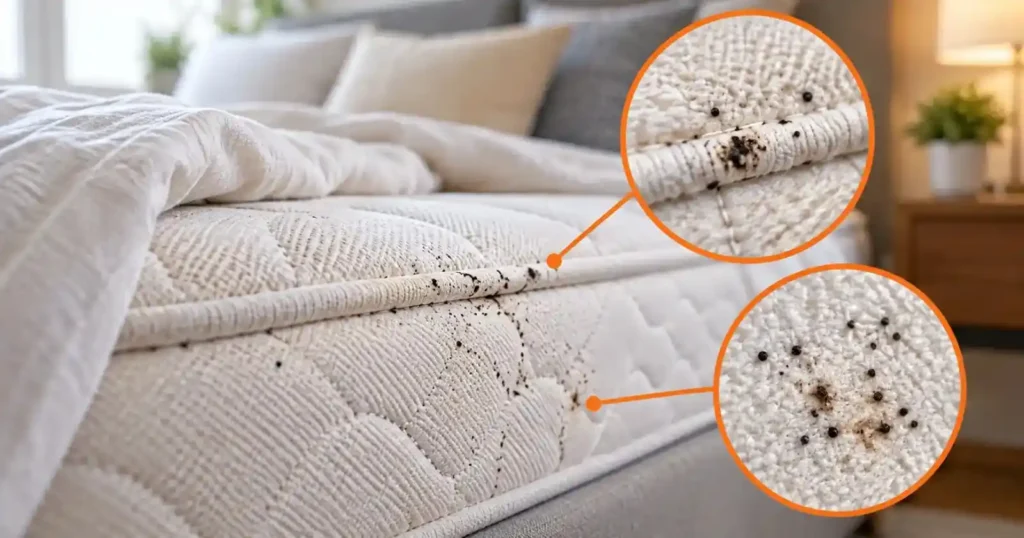
Bed bug waste often appears as tiny dark dots or stains. The marks may look like spots made by the tip of a black felt-tip pen. They are commonly found near mattress seams, bedding, box springs, bed frames, furniture, and other places where the insects hide.
These marks alone do not always prove that you have an active infestation. However, when dark spots appear together with live bugs, shed skins, eggs, or unexplained blood marks, the chance of bed bug activity becomes much higher.
Illinois homeowners who notice suspicious marks can also review Signs of Bed Bugs in Illinois to compare fecal spotting with other common warning signs.
This guide explains what the stains look like, where you may find them, how to tell them apart from other marks, and when professional inspection may be the right next step.
What Is Bed Bug Poop?
Bed bug poop is waste left behind after a bed bug feeds and digests a blood meal.Because bed bugs feed on blood, their waste looks very different from normal household dirt. It usually appears dark brown, black, or almost black.The marks may be very small. In many cases, people notice the stains before they ever see a live insect.
These spots are often found close to where bed bugs rest between meals.That means the location of the marks can provide useful clues about where insects may be hiding.
Bed bugs commonly stay close to beds, couches, upholstered chairs, and other places where people rest for long periods.
If you want to understand their hiding behavior in more detail, see Where Do Bed Bugs Hide in Illinois Homes?.
What Do Bed Bug Droppings Look Like?
Bed bug droppings usually look like tiny black or dark brown dots.
Some marks are round and sharply defined. Others may soak into fabric and create a small stain.On light-colored sheets or mattress fabric, the spots can stand out clearly.On dark furniture or patterned bedding, they may be much harder to notice.
Fresh marks may appear darker and slightly wet at first. Older stains usually dry into flat spots.Unlike loose dirt, the marks may soak into fabric instead of brushing away easily.
If you see several dark spots grouped around mattress seams or furniture joints, inspect the surrounding area carefully.Bed bugs often leave multiple signs close to their hiding places.
What Does Bed Bug Poop Look Like on Fabric?
On fabric, the stain may resemble a tiny ink mark.This is because liquid waste can soak into sheets, mattress covers, pillowcases, or upholstery.
Some marks remain very small. Others spread slightly into the material.Dark stains may appear alone or in small groups.If you find several spots around the same mattress seam, check closely for other evidence such as eggs, shed skins, or live insects.
Bed bug waste is often concentrated in areas where insects repeatedly hide.That pattern can make the location of the stains just as important as their appearance.
What Are Bed Bug Feces?
Bed bug feces are digested blood waste produced after feeding.
The dark color comes from the blood that has passed through the insect’s digestive system.These marks are different from fresh human blood.Fresh blood stains often appear red or rusty.Bed bug waste tends to appear dark brown or black.
However, color alone is not enough to identify an infestation.
You should consider where the marks are located and whether other bed bug signs are present nearby.A single dark dot on a sheet may have many possible causes.
Several dark stains around mattress seams, combined with shed skins or live bugs, deserve closer attention.
Bed Bug Feces vs. Bed Bug Excrement
The phrase bed bug excrement simply refers to the waste produced by bed bugs.
Homeowners may use terms such as poop, feces, droppings, or excrement to describe the same general sign.
Whatever term you use, the important point is that these waste marks can help identify areas where bed bugs are spending time.They commonly appear around:
Mattress seams, box spring edges, headboards, bed frames, nearby furniture, upholstered couches, baseboards, and cracks close to sleeping areas.If signs are found in several parts of the room, the infestation may have spread beyond the mattress.
What Does Bed Bug Poop Look Like on Sheets?
Bed bug poop on sheets may appear as tiny black or dark brown dots.Some stains look almost like a pen touched the fabric.
Others may appear slightly smeared if they were disturbed before drying.You may also notice small reddish or rusty stains nearby.
Those reddish marks may come from blood or a bug being crushed during sleep.The darker fecal spots are usually more useful for locating areas of repeated activity.If you find suspicious spots on the sheets, remove the bedding carefully and inspect the mattress underneath.
Pay close attention to seams, piping, labels, corners, and folds.Do not carry suspected bedding through other rooms without containing it first, because moving infested items can spread insects.
What Does Bed Bug Poop Look Like on a Bed?
Bed bug poop on bed surfaces may appear in several locations.Do not check only the sheets.Inspect the mattress, box spring, frame, headboard, slats, and nearby furniture.
Dark marks around screw holes or wooden joints can be especially important because those narrow spaces may provide hiding areas.You may also find stains behind a headboard or on the wall where the bed touches it.A complete inspection is more useful than simply changing the bedding.
If insects have moved into furniture or cracks around the room, the mattress may show only part of the problem.
What Does Bed Bug Poop Look Like on a Mattress?
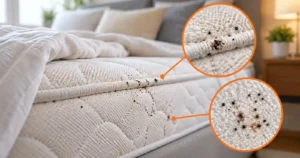
Bed bug poop on mattress fabric commonly looks like small black dots or short dark stains.The seams and piping are among the first areas you should inspect.
Slowly work around the full edge of the mattress.Check labels, handles, stitched areas, corners, and folds.
Then lift the mattress and inspect the underside.The box spring should also be checked because bed bugs can hide around fabric edges, staples, and wooden framework.
Dark spotting in these protected areas is more suspicious than one isolated mark in the middle of the mattress.
Homeowners who confirm several warning signs may want to review Bed Bug Control Services in Illinois before trying random DIY treatments.
What Do Bed Bug Fecal Stains Look Like?
Bed bug fecal stains are usually small, flat, and dark.Their size can vary.Some look like pinpoints. Others spread slightly into absorbent material.On wood or hard surfaces, the marks may stay more defined.On fabric, they can soak in.
A cluster of stains around a crack or seam may suggest that bed bugs have been resting nearby.Do not assume every dark spot is caused by bed bugs.Mold, dirt, ink, food, and other insects can also leave marks.That is why proper identification matters before treatment begins.
Bed Bug Poop Stains vs. Blood Stains
Bed bug poop stains and blood stains can appear on the same bedding, but they often look different.Waste is generally darker.Blood stains may appear red, rusty, or brownish-red.Small blood marks can appear when a recently fed insect is crushed.Dark fecal spotting is more likely to look like a black pen dot or stain.If both types of marks appear together around a sleeping area, inspect the bed closely.
Also look for pale eggs, shed skins, or live reddish-brown insects.Several signs together provide stronger evidence than one stain by itself.
What Do Bed Bug Droppings on a Mattress Look Like?
Bed bug droppings on mattress surfaces are often easiest to see on light-colored fabric.Look around stitched seams and edges.A group of dark dots concentrated in one small area may indicate a nearby hiding site.Use a flashlight when inspecting.Move slowly because young bed bugs and eggs can be difficult to see.Check the bed frame after examining the mattress.Pay attention to cracks, screw holes, joints, and the area behind the headboard.Do not stop the inspection simply because you do not see a live insect.Bed bugs are good at staying hidden.
What Do Bed Bug Droppings on Sheets Look Like?
Bed bug droppings on sheets can look like tiny dark dots that have soaked into the material.The pattern may be random, or several spots may appear close together.Do not confuse these marks with lint, crumbs, or loose dirt.Loose debris can often be brushed away.A stain that has soaked into fabric will remain.Still, the presence of a dark spot does not confirm an infestation by itself.Inspect the surrounding sleeping area before reaching a conclusion.
Can Bed Bug Feces Appear on a Wall?
Yes. Bed bug feces on wall surfaces may appear when insects are hiding behind headboards, wall decorations, loose trim, baseboards, or nearby cracks.
You may notice tiny black dots where the bed meets the wall.In larger infestations, signs may appear farther away from the mattress.Check around picture frames, wall joints, electrical cover plates, baseboards, and the back of furniture.Do not spray pesticides or liquids into electrical outlets.
If you suspect insects are using wall gaps or electrical areas, a professional inspection is safer.
What Does Bed Bug Feces Look Like?
People searching what does bed bug feces look like are usually trying to separate bed bug signs from ordinary dirt.The clearest clues are color, pattern, location, and other nearby evidence.Bed bug waste is usually:Dark brown to black, very small, flat after drying, and often found close to bed bug hiding areas.It may look like an ink dot rather than a pellet.That last point is important.
Some household pests leave solid pellets or larger droppings.Bed bug waste is usually seen as staining or spotting.
Can Pictures Help Identify Bed Bug Waste?
A bed bugs excrement picture can help you understand the general appearance of spotting, but photographs have limits.
Lighting, fabric color, camera quality, and stain age can change how a mark looks.A black spot in an online photo may resemble mold, ink, flea dirt, or another stain in your own home.Use pictures as a comparison tool, not as the only proof.Your inspection should also consider the location of the stain.
Dark spots found deep inside a mattress seam are more meaningful when eggs, skins, or insects are present nearby.
If you are unsure, capture a live insect or take clear photos of several signs for professional identification.
How Can You Tell Bed Bug Waste From Dirt?
Dirt often sits on top of a surface.It may brush, shake, or vacuum away.Bed bug waste may soak into absorbent material.This is why spots can remain visible even after loose debris has been removed.Location also matters.Random dirt can appear anywhere.
Bed bug activity is more likely to be concentrated around areas where people sleep or sit for long periods.Look for repeated patterns near seams, headboards, furniture joints, or couches.Also inspect for shed skins and eggs.The goal is not to identify a single dot.The goal is to understand the full pattern of evidence.
Does Bed Bug Waste Smear?
Some fresh or damp spots may smear.However, you should not rely on a smear test as your only method of identification.The age of the mark, the surface material, moisture, and cleaning products can all affect what happens when a stain is touched.Instead of rubbing suspicious marks repeatedly, inspect the surrounding area.Look for physical insects, eggs, shells, stains, and hiding sites.These clues provide a clearer picture.
Does Bed Bug Waste Have a Smell?
A few fecal spots usually do not create an obvious smell.Larger infestations may be associated with a noticeable sweet or musty odor.However, many other things inside a home can create similar odors.Do not diagnose an infestation based on smell alone.Dark spotting and physical evidence are more useful.
If a strange odor appears together with repeated stains, shed skins, and live bugs, professional inspection may be worthwhile.
Where Should You Look for Bed Bug Waste?
Start with the areas closest to where people sleep.Inspect the mattress first.Then check the box spring, frame, headboard, nightstands, baseboards, and furniture near the bed.
If signs are found there, expand your search.Inspect couches and upholstered chairs if people regularly rest on them.Check curtain folds, furniture seams, cracks, carpet edges, and wall gaps.Bed bugs prefer narrow hiding areas where their flat bodies can remain protected.
Finding several signs in multiple rooms may indicate a larger infestation.
What Other Signs Should You Look For?
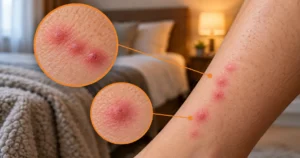
Fecal spotting is only one part of bed bug identification.Look for live insects.Adult bed bugs are small, flat, oval, and reddish-brown.Young bed bugs can be lighter in color and harder to see.You may also find pale eggs or empty shed skins.Bites can occur, but bites alone are not reliable proof because many insects and skin conditions can cause similar marks.If you find a suspicious insect, place it in a sealed clear container or bag rather than crushing it.A professional may be able to identify it.
How Do Bed Bugs Reach Illinois Homes?
Bed bugs are hitchhikers.They can travel on luggage, bags, clothing, furniture, and personal belongings.They do not require a dirty home.A clean apartment can develop a bed bug problem just as easily as a cluttered property if insects are carried inside.
Travel, visitors, shared housing, and used furniture are common opportunities for bed bugs to move.
Reducing clutter does not guarantee prevention, but it can make inspections easier by removing extra hiding spaces.
What Should You Do After Finding Suspected Droppings?
Do not panic and do not immediately throw away your mattress.First, inspect the area carefully.Check the mattress, frame, headboard, nearby furniture, and baseboards.Avoid moving items into other bedrooms.Moving an infested object can carry bed bugs with it.If possible, photograph the stains and capture any insect you find.Do not spray random household chemicals on bedding or furniture.Treatment should match the actual pest and infestation level.
For general local help, Illinois property owners can review Pest Control Illinois services offered by Perfect Pest Control LLC.
When Is Professional Bed Bug Treatment Worth Considering?
Professional help becomes more important when you find several signs at the same time.For example, dark spotting together with eggs, shed skins, or live insects is more concerning than one isolated stain.
Activity in more than one room is another reason to seek help.Bed bugs can hide deep inside furniture, wall gaps, baseboards, and other spaces that are easy to miss.
Professional inspection can help determine how far an infestation has spread before treatment starts.If treatment is needed, methods vary based on property type and infestation level.
Homeowners comparing options can read Bed Bug Heat Treatment vs. Chemical Treatment to understand the differences between two common approaches.
Can You Clean Bed Bug Stains Without Treating the Infestation?
Cleaning may remove visible marks, but cleaning the stain does not eliminate hidden insects.If active bed bugs remain inside the mattress, furniture, or room, new spots can appear.This is why the source of the staining matters more than the appearance alone.You can clean suitable bedding according to the care label.
Items that can safely be dried with heat may also be handled according to appropriate bed bug control guidance.
However, do not treat cleaning as a replacement for inspection when several signs are present.The infestation itself must be addressed.
How Can You Reduce the Risk of Future Bed Bug Problems?
Inspect luggage after travel.Check secondhand furniture before bringing it indoors.Keep sleeping areas easy to inspect.Reduce unnecessary clutter near beds.
Watch mattress seams and furniture joints for new activity.If you live in an apartment building, report suspected activity early.Waiting can allow the problem to spread into nearby rooms or units.The faster you confirm what you are dealing with, the easier it becomes to choose an appropriate response.
How Much Can Professional Treatment Cost?
There is no single price for every infestation.Cost can depend on the number of affected rooms, size of the property, severity of activity, preparation requirements, and treatment method.A small problem confined to one room may require a different plan from a widespread infestation in a multi-unit property.
Chicago homeowners who want more information about pricing factors can read Bed Bug Extermination Cost in Chicago.
An inspection is often the best way to understand what treatment may be needed instead of choosing a service based only on a general online price.
When Should You Call Perfect Pest Control LLC?
If you keep finding dark spots around your mattress, sheets, furniture, or walls, look for additional evidence before assuming the marks are harmless.
Multiple signs may mean bed bugs are hiding nearby.Perfect Pest Control LLC serves Illinois and Chicagoland properties and provides bed bug inspection and treatment services.
A professional inspection can help determine whether the marks are consistent with bed bug activity and where the infestation may be hiding.
Call Perfect Pest Control LLC at (630) 447-9777 if you have found suspicious staining, live insects, eggs, or shed skins and want help confirming the problem.
Frequently Asked Questions
What Does Bed Bug Poop Look Like?
It usually appears as tiny black or dark brown spots. The marks often resemble small ink dots and may soak into sheets, mattresses, or other fabric.
Are bed bug fecal spots always black?
They are commonly very dark brown or black after drying. Appearance can vary depending on the surface, age of the stain, and lighting.
Can bed bug waste appear without seeing live bed bugs?
Yes. Bed bugs spend much of their time hidden, so stains may be noticed before an insect is seen. Inspect nearby seams, cracks, furniture, and bed frames carefully.
Can bed bug stains wash out of sheets?
Some stains may fade or come out during cleaning, while others can remain visible. Removing the stain does not eliminate an active infestation.
Does one black spot mean I have bed bugs?
No. A single dark spot can have many causes. Several stains around common hiding areas, especially with eggs, skins, or live insects, provide stronger evidence.
Should I call an exterminator if I find dark spots on my mattress?
Consider professional inspection if you find repeated dark spotting together with other bed bug signs or if the marks continue appearing after you inspect and clean the sleeping area.