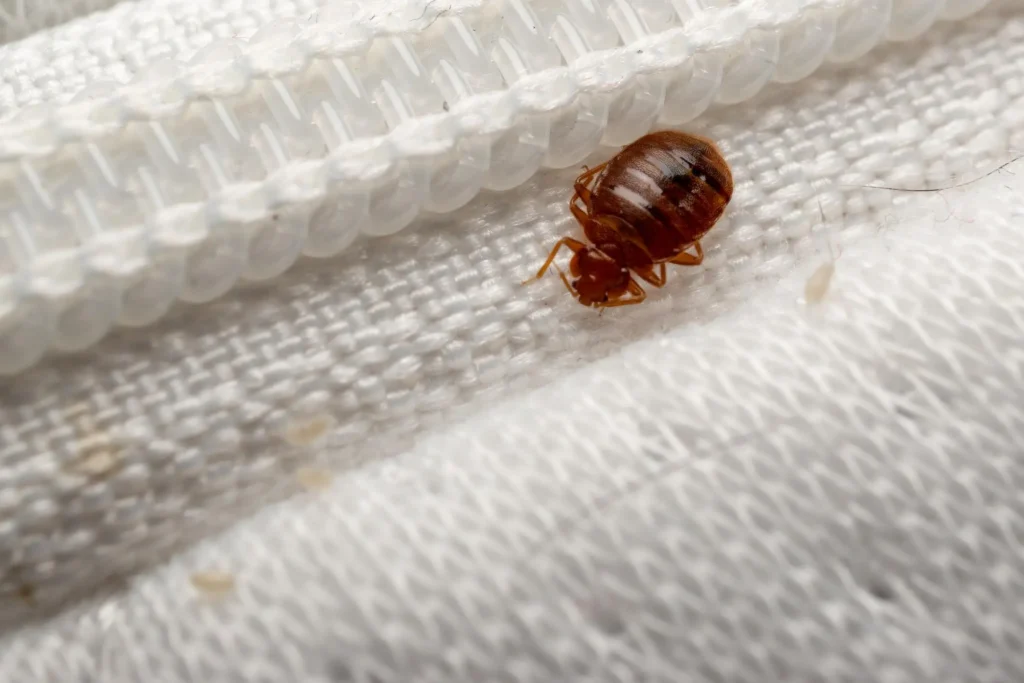
Bed bugs usually hide during the day in mattress seams, box springs, bed frames, headboards, couches, furniture joints, and small cracks near sleeping areas. Their flat bodies allow them to squeeze into narrow spaces where homeowners may not notice them.
If you’re wondering where do bed bugs hide during the day in Illinois, the answer depends on where people sleep, rest, and spend extended periods sitting still. These insects generally prefer dark, protected spaces close to a potential blood meal.
Bed bugs are most active at night, but they can also move and feed during daylight hours. They are not limited to bedrooms, and hiding places can become more widespread as an infestation grows.
This guide explains where to look, how to identify hidden bed bugs, and when professional pest control may be necessary to protect your Illinois home.
Why Do Bed Bugs Hide During the Day?
Bed bugs are primarily nocturnal insects, meaning they tend to be more active at night. They usually emerge from their hiding places when people are sleeping or resting.
After feeding, they return to small cracks, crevices, or fabric folds where they remain protected.
Unlike fleas or ticks, bed bugs do not normally live on the human body. They spend much of their time hidden in the surrounding environment.
Their preferred hiding locations provide three important advantages:
- Protection: Narrow cracks make them difficult to see or disturb.
- Access to people: Staying near beds and sofas reduces the distance they must travel to feed.
- Suitable shelter: Furniture joints, fabric seams, and other enclosed spaces offer places to rest, lay eggs, and develop.
Bed bugs can feed during the day when a suitable host is available, especially in rooms where people regularly sleep during daylight hours.
Therefore, daytime inactivity should not be mistaken for an infestation disappearing.
Common Bed Bug Hiding Places Inside Illinois Homes
The common bed bug hiding places are typically found in bedrooms, living rooms, and nearby furniture.
However, bed bugs can also occupy unexpected areas, particularly when an infestation has been present for some time.
| Location | Areas to inspect | What to look for |
| Mattress | Seams, piping, folds, labels | Live insects, dark stains, eggs |
| Box spring | Fabric edges, underside, frame | Shed skins, eggs, insects |
| Bed frame | Joints, screw holes, support slats | Dark spots, clustered insects |
| Headboard | Rear surface, mounting points | Live bugs, fecal markings |
| Sofa | Cushion seams, upholstery folds | Insects, eggs, shed skins |
| Dresser | Drawer joints, undersides | Small insects, dark marks |
| Baseboards | Cracks and wall-floor gaps | Insects, shed skins |
| Wall fixtures | Gaps around plates and fixtures | Insects near accessible edges |
These locations are not equally likely in every home.
During the early stages of an infestation, bed bugs are often concentrated around the place where people sleep. As their population grows, they may spread into additional furniture and structural openings.
For a broader room-by-room overview, read Where Do Bed Bugs Hide in Illinois Homes?
Where Do Bed Bugs Hide in Your Home?
If you’re asking where do bed bugs hide in your home, start with the areas where someone spends several hours sleeping or resting.
Bedrooms are usually the first places to inspect, followed by couches, recliners, and nearby furniture.
Bed bugs prefer small spaces that allow their flattened bodies to remain hidden. They may occupy gaps only a few millimeters wide, making them difficult to find without a careful inspection.
Where Do Bed Bugs Hide in Mattresses?
One of the first questions homeowners ask is where do bed bugs hide in mattresses.
The most likely locations include mattress piping, stitched seams, fabric folds, and areas around labels or handles.
These locations provide narrow, protected spaces near a sleeping person.
When inspecting a mattress, look carefully along the edges rather than checking only the flat sleeping surface.
Pay attention to dark fecal marks, pale shed skins, tiny eggs, and live insects.A mattress can look clean on top while insects remain hidden beneath its seams.
If you are unsure whether the insect you found is a bed bug, see How to Identify Bed Bugs in Your Illinois Home for additional identification guidance.
Can Bed Bugs Hide in Bed Frames?
Yes. Can bed bugs hide in bed frames is an important question because many infestations extend beyond the mattress.
Bed bugs commonly shelter in joints, screw holes, wooden support slats, and gaps between connected frame components.
Wooden bed frames can offer numerous narrow crevices, although metal frames are not immune to infestation.Headboards deserve special attention.Bed bugs may hide behind headboards, inside mounting brackets, or between a headboard and the wall.
When a professional inspects an infested bedroom, examining these areas is often necessary to determine how far the infestation has spread.
Do Bed Bugs Hide in Box Springs?
Yes. The answer to do bed bugs hide in box springs is that they can provide some of the most protected hiding areas around a bed.
Insects may gather along the upper seams, beneath fabric edges, and near wooden supports.The thin fabric covering underneath a box spring can conceal bed bugs and their eggs.A complete inspection may require checking the underside and inspecting accessible structural areas without unnecessarily spreading the insects.
Bed-bug-resistant encasements can make box springs easier to monitor and reduce available hiding locations.
Where Do Bed Bugs Hide in Furniture?
Understanding where do bed bugs hide in furniture is essential because an infestation may affect more than the bedroom.
Bed bugs can establish hiding places in upholstered furniture, wooden joints, and small openings beneath or behind frequently used seating.
Nightstands and dressers located beside beds are especially important to inspect.Look around drawer joints, the undersides of furniture, recessed screw holes, and any gaps where two surfaces meet.
Can Bed Bugs Hide in Couches?
Yes. Can bed bugs hide in couches is particularly relevant for households where family members regularly nap or sleep on a sofa.Bed bugs can occupy cushion seams, armrests, upholstery folds, and the underside of a couch.Recliners may provide additional hiding spaces inside their moving mechanisms.
When checking a couch, remove loose cushions carefully and inspect the fabric seams and accessible frame.
Pay particular attention to sections where people commonly sit or rest.
Do not immediately move a suspected infested sofa into another room. Doing so can transfer insects to previously unaffected areas.
Other Upholstered and Wooden Furniture
Bed bugs may also hide in upholstered chairs, bedroom benches, and nearby wooden furniture.Furniture with numerous seams, joints, and decorative details can be harder to inspect.
Secondhand furniture deserves particular attention because bed bugs can travel into a home inside an infested item.
Inspect used furniture thoroughly before bringing it indoors.
Do Bed Bugs Hide in Walls and Cracks?
Yes. Do bed bugs hide in walls and cracks is an important concern in both single-family homes and apartment buildings.Bed bugs can shelter behind baseboards, beneath loose wallpaper, around wall trim, and inside accessible structural gaps.
They may also move through connected openings between rooms or neighboring apartment units.These areas become especially important when an infestation extends beyond the bed.In multifamily properties, coordinated inspections may be necessary because insects can move between connected living spaces.
A pest control professional can assess whether adjoining rooms or units should be inspected.
Can Bed Bugs Hide in Electrical Outlets?
Yes. Can bed bugs hide in electrical outlets and surrounding wall openings? They can occupy protected gaps around outlet covers, switch plates, and electrical boxes.
However, homeowners should not remove electrical covers, insert tools into energized openings, or spray insecticides into electrical outlets.These actions can create shock, fire, or chemical exposure hazards.If insects appear to be emerging from an electrical fixture, ask a qualified pest control professional to evaluate the location and coordinate safe access when necessary.
Do Bed Bugs Hide in Clothes and Closets?
Sometimes. Do bed bugs hide in clothes and closets is another concern when insects have spread beyond sleeping furniture.
Bed bugs may hide in folded clothing, bags, clutter, and belongings stored near an infested bed.
They are less likely to choose frequently disturbed clothing as a long-term hiding location, but they can travel with items moved between homes, hotels, and apartments.Inspect clothing storage near affected sleeping areas and avoid transporting suspected infested belongings without containment.
Suitable fabrics can be treated in a clothes dryer on high heat for approximately 30 minutes, provided the manufacturer’s care instructions allow it.
Where Do Bed Bugs Hide Besides Beds?
If you are wondering where do bed bugs hide besides beds, remember that any protected location near a resting person may provide shelter.
Additional locations include:
- Behind picture frames and wall decorations
- Inside the joints of bedside tables
- Along carpet edges
- Behind loose wallpaper
- In curtain folds
- Inside luggage and backpacks
- Around wall-mounted headboards
- In stored items near sleeping areas
Finding bed bugs away from a mattress does not necessarily mean the entire property is heavily infested.
However, insects in multiple locations may indicate that the problem has spread and requires a more extensive inspection.
Homeowners should avoid treating only the mattress while ignoring nearby furniture and structural gaps.
How to Find Bed Bugs During the Day
Learning how to find bed bugs during the day can help homeowners identify possible infestations without waiting until nighttime.
A careful inspection requires patience, good lighting, and an understanding of where insects are most likely to shelter.
Step 1: Gather Inspection Supplies
Use a bright flashlight, a magnifying glass if available, and a clear sealed container for collecting a suspected insect.A phone camera may also help document findings.Avoid disturbing large amounts of furniture before confirming what you are seeing.
Step 2: Examine Mattress Seams
Begin at one corner of the mattress and inspect the piping and seams around the entire perimeter.Check labels, handles, and folds.Look for tiny insects, dark marks, pale eggs, or empty skins.
Step 3: Inspect the Box Spring and Bed Frame
Check accessible seams, joints, screw holes, and the underside of the bed.Pay special attention to wooden support pieces and headboard connections.Avoid dismantling heavy furniture if doing so could cause injury or scatter insects.
Step 4: Check Nearby Furniture
Examine nightstands, dressers, chairs, and upholstered furniture close to the sleeping area.Inspect drawer joints and accessible undersides.
Step 5: Look Along Walls and Baseboards
Use your flashlight to inspect cracks behind the bed, trim, and the junction between the floor and wall.Do not open energized electrical fixtures during a DIY inspection.
Step 6: Capture and Identify Suspected Insects
If you find an insect that looks like a bed bug, place it in a sealed container or photograph it clearly.
Correct identification is important because carpet beetles, bat bugs, and other insects may be mistaken for bed bugs.
Step 7: Avoid Spreading the Infestation
Do not carry potentially infested bedding or furniture into unaffected rooms.Keep suspected belongings contained and seek advice about appropriate treatment.A systematic inspection is usually more effective than randomly searching the entire house.
Signs of Hidden Bed Bug Infestation
The signs of hidden bed bug infestation are not limited to visible insects.
Because bed bugs spend much of their time concealed, indirect evidence may be the first indication of a problem.
Dark Fecal Spots
Small black or dark brown marks on mattress seams, furniture, or bedding may be bed bug droppings.These spots can appear like ink stains and may be concentrated near hiding areas.For a closer explanation of these markings, read What Does Bed Bug Poop Look Like?
Reddish Stains on Bedding
Rust-colored or reddish spots may appear when a recently fed bed bug is crushed.However, staining alone is not enough to confirm an infestation.
Shed Skins and Eggs
Bed bugs shed their outer coverings as they grow.You may find pale, empty skins and tiny whitish eggs near mattress seams or furniture joints.
Live Insects
Adult bed bugs are small, oval-shaped, flat, and reddish-brown.Young bed bugs are smaller and may be pale before feeding.
Unexplained Bites
Some people experience itchy red bumps after bed bug bites, while others have no visible reaction.
Skin reactions vary, and bites alone cannot establish that bed bugs are present.
For more information about these symptoms, see What Do Bed Bug Bites Look Like? Signs and Symptoms in Illinois.
A complete overview of possible warning signs is available in Signs of Bed Bugs in Illinois.
How to Get Rid of Hidden Bed Bugs
Understanding how to get rid of hidden bed bugs involves more than applying a household insecticide.
These insects can occupy numerous protected locations, and their eggs may remain concealed during an incomplete treatment.An effective approach generally involves careful identification, inspection, treatment, and follow-up monitoring.
Reduce Clutter Carefully
Remove unnecessary clutter around sleeping areas to reduce hiding places.Keep potentially infested belongings contained instead of moving them through the house.
Vacuum Accessible Areas
Vacuum mattress seams, bed frames, furniture joints, and baseboards where evidence has been found.Dispose of vacuum contents promptly in a sealed bag outside the living area.Vacuuming may remove some insects, but it should not be relied upon as the only treatment.
Use Appropriate Heat Treatment
High dryer temperatures can kill bed bugs and eggs in suitable clothing and bedding.Professional heat treatments may also be used for larger areas or items that cannot be placed in a dryer. Do not attempt to heat an entire home with space heaters, a fireplace, or by increasing the thermostat setting.
These methods are unsafe and do not provide reliable bed bug control.
Consider Mattress Encasements and Interceptors
Bed-bug-resistant mattress encasements help eliminate some hiding locations and make future inspections easier.Interceptor devices under bed legs can help monitor bed bug movement.These methods work best as part of a broader pest management strategy.
Use Pesticides Safely
If pesticides are needed, use only products registered for bed bugs and follow their labels.
Avoid applying outdoor pesticides inside your home or spraying bedding unless the product label explicitly permits that use.
Bug bombs and foggers should not be the primary treatment because they often fail to reach insects hidden inside cracks.
Arrange Professional Inspection and Treatment
Professional pest control may be appropriate when bed bugs are confirmed, evidence appears in several locations, or previous efforts have failed.
Depending on the infestation, a professional may recommend heat treatment, targeted insecticide applications, steam, monitoring devices, and follow-up visits.
If you’re evaluating these methods, see Bed Bug Heat Treatment vs. Chemical Treatment in Illinois.
Why Hidden Bed Bugs Are Difficult to Eliminate in Illinois Homes
The challenge with bed bugs is not unique to Illinois. Their small size, ability to shelter in narrow gaps, and tendency to remain close to resting areas make them difficult to detect in any region.
Illinois homes can have varied layouts, from detached houses to apartments and multifamily buildings.A single-family property may require a detailed inspection of bedrooms, living rooms, and nearby storage areas.
In an apartment building, the inspection may also need to consider neighboring units and connected structural openings.Winter weather does not reliably eliminate bed bugs inside heated properties.
Indoor heating allows these pests to survive even when outdoor temperatures fall below freezing.
Property owners should focus on proper identification and an evidence-based treatment plan rather than relying on seasonal temperature changes.
When Should You Call a Bed Bug Exterminator?
You should consider professional assistance when you find confirmed bed bugs, discover insects in multiple rooms, or continue seeing new evidence after taking reasonable control measures.
Other situations that may warrant professional evaluation include an infestation in a multifamily property, difficulties locating hiding places, or an unsuccessful previous treatment.
A qualified professional can assess the extent of the problem and determine which control methods are appropriate.
Treatment prices depend on several factors, including the property size, number of affected rooms, severity of infestation, and treatment method.
For information about potential pricing considerations, read Bed Bug Extermination Cost in Chicago.
Looking for Bed Bug Control in Illinois?
Discovering hidden bed bugs can be frustrating, especially when you cannot locate the source of an infestation.Professional inspection can help identify affected areas and determine whether treatment is necessary.
If your Illinois property needs assistance, contact a pest control provider that serves your location and ask about inspection procedures, treatment options, and follow-up recommendations.
For service information, visit Bed Bug Control Services in Illinois after confirming the relevant service page and coverage area.
Frequently Asked Questions
1. Can bed bugs be active during the day?
Yes. Although bed bugs are generally more active at night, they can move and feed during daylight hours, particularly when a person sleeps during the day or the insects are disturbed.
2. Can bed bugs hide in a clean bedroom?
Yes. Bed bugs are attracted to the availability of a blood meal, not household dirt. Clean bedrooms can still provide suitable shelter in mattresses, furniture joints, and other small openings.
3. Can you have bed bugs without seeing any insects?
Yes. Small infestations may remain difficult to detect because insects hide in narrow spaces. Dark fecal spots, eggs, and shed skins can provide additional evidence.
4. Do bed bugs stay in one room?
Not necessarily. Bed bugs can spread through belongings, furniture, and connected spaces. The extent of their movement varies with the property and infestation.
5. Can sleeping in another room stop bed bugs from biting?
Moving to another bedroom is not a reliable solution. Bed bugs may follow people or be transported with belongings, potentially spreading the problem.
6. Should you throw away an infested mattress?
Not automatically. Some mattresses can be treated and enclosed in specialized protective encasements. Discarding furniture without proper precautions may spread insects to other areas.
7. Will bed bugs disappear if a room is left empty?
Not reliably. Bed bugs can survive for extended periods without feeding. Leaving a room unused does not guarantee that the insects will die.
Final Thoughts
Bed bugs generally spend daylight hours hiding in protected areas near sleeping or resting people. Mattress seams, box springs, bed frames, headboards, couches, furniture joints, and wall cracks are among the most important places to inspect.Finding the insects early can help prevent a more extensive infestation and make treatment planning easier.If you notice live insects, dark fecal spots, shed skins, or other suspicious evidence, begin with careful identification and avoid moving potentially infested belongings throughout your home.
When an infestation is confirmed or difficult to locate, contact a qualified pest control professional serving your Illinois area to discuss inspection and treatment options.